



Anyone ordering a part, training a new operator, or trying to describe what broke needs a shared vocabulary for an excavator's components. This guide covers excavator parts name by name, section by section, so you can identify exactly what you're looking at and know what to call it when you order a replacement.
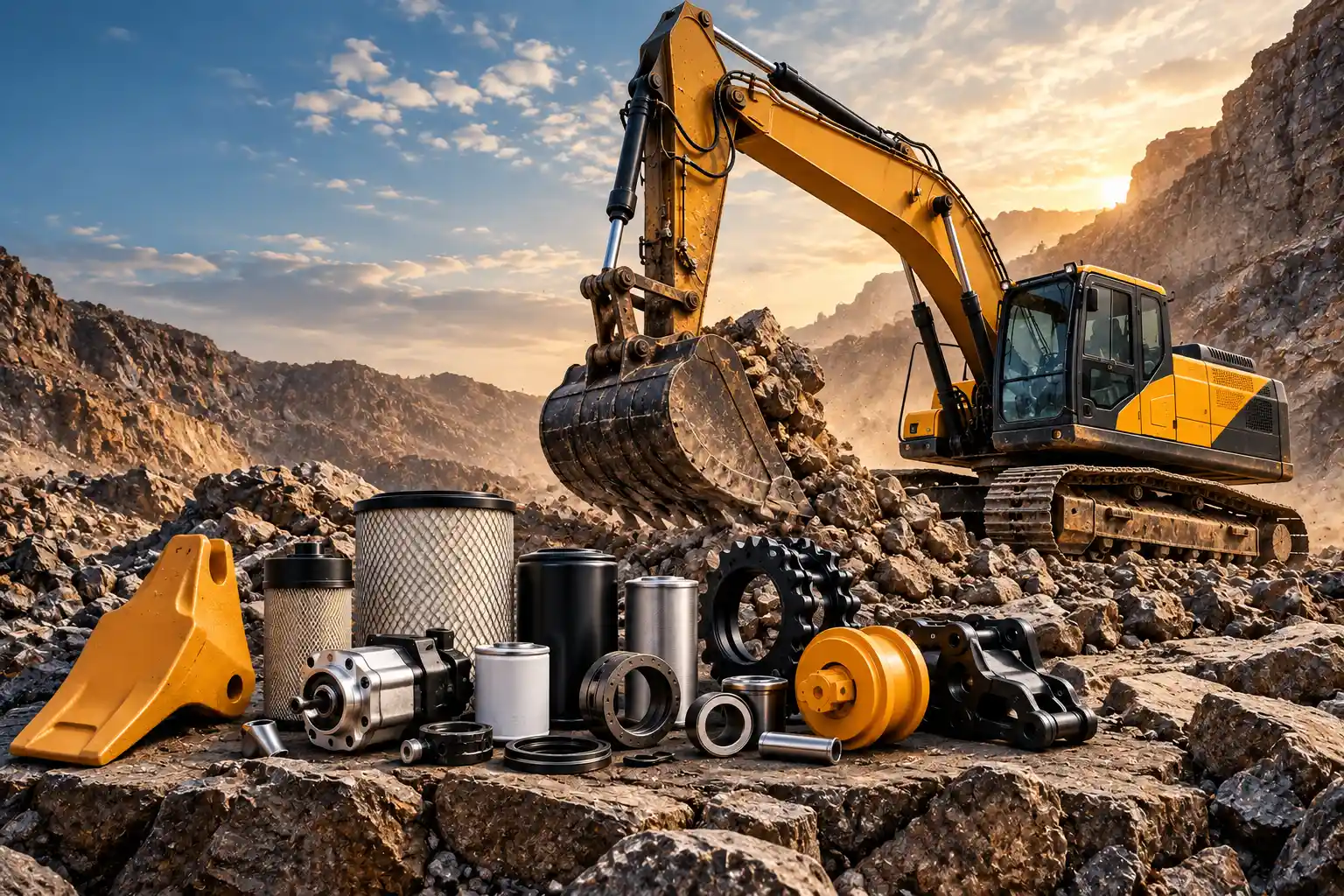
An excavator is built from three main sections, and almost every part you'll ever need to name belongs to one of them. The front attachment, made up of the boom, arm and bucket, does the actual digging. The house sits on top of the undercarriage and carries the cab, engine and hydraulic system, rotating independently of the tracks beneath it. The undercarriage itself sits at the bottom, carrying the whole machine's weight while providing travel. Once you know which of these three sections a part belongs to, working through an excavator parts list or checking a part against an excavator becomes far easier, because every component's name and position follow from where it sits in that structure.
1. The Three Main Sections of an Excavator
Every excavator parts list, however detailed, ultimately groups components into these three functional sections. The front attachment performs the digging, the house provides power and control, and the undercarriage provides movement and support. This grouping also tells you where to look when something goes wrong: front-attachment wear shows up at the digging end, house issues surface in the cab or engine bay, and undercarriage wear shows up underneath the machine, on both sides. With that structure in mind, the rest of this guide works through each section in turn.
2. Front Attachment Parts (Digging Equipment)
The front attachment is the visible working end of the excavator, and its three main sections move together to dig, lift and place material.
2.1 Boom
The boom is the first arm section, pinned directly to the house. Its length and configuration set the machine's reach and digging depth, and different boom types suit different jobs: knuckle booms add side-to-side movement for working around obstacles, while long-reach booms extend the working range without repositioning the machine.
2.2 Arm (Stick)
Attached to the far end of the boom is the arm, sometimes called the stick, which connects the boom to the bucket. The stick's length affects both digging depth and breakout force, and it moves on its own hydraulic cylinder, separate from the one driving the boom.
2.3 Bucket
At the working end of the arm sits the bucket, the digging and material-carrying attachment that most people picture first when they think of an excavator. Bucket type and width are chosen by application, with narrow trenching buckets, wide grading buckets and heavy-duty rock buckets covering most jobs.
2.4 Bucket Teeth and Ground Engaging Tools (GET)
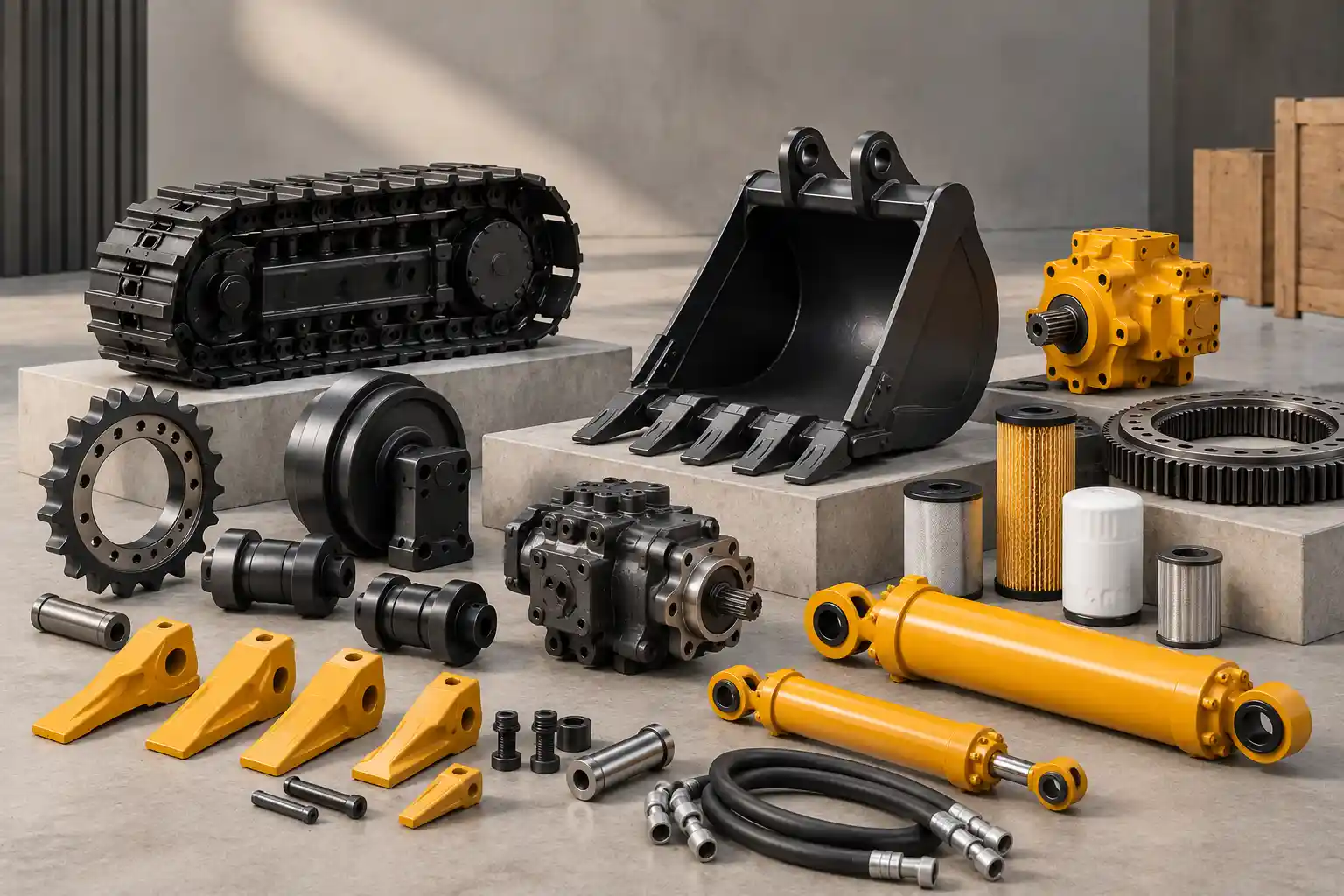
Bolted or pinned to the bucket lip are the tooth points, adapters and side cutters known collectively as ground engaging tools, or GET. These wear faster than any other front-attachment part, since they make first contact with the material being dug and are deliberately designed to be sacrificial. Matching tooth profile and adapter type to the ground condition affects both penetration and how often the set needs replacing.
2.5 Linkage and Cylinders
Holding the whole attachment together are the pinned connecting arms, known as the bucket linkage, and the hydraulic cylinders for the boom, arm and bucket that convert hydraulic pressure into digging force. Pin and bushing wear in this linkage is one of the most common sources of excess play across the front attachment.
3. House (Upper Structure) Parts
Above the undercarriage and behind the front attachment sits the house, the section that carries the operator, the power source and the systems that drive everything else on the machine.
3.1 Cab
The cab is the operator's enclosed control station, built to ROPS, or roll-over protection, standards. It houses the joysticks, pedals and displays used to control travel, swing and the front attachment, and it's usually the first place an operator will notice a control or visibility issue.
3.2 Counterweight
Mounted at the rear of the house is the counterweight, a heavy steel block whose sole job is to balance the weight of the front attachment during lifting and digging, preventing the machine from tipping forward under load.
3.3 Engine
The engine powers the hydraulic pumps that drive every function on the machine, from travel to swing to the front attachment, and its access panels sit behind or beside the cab. Because the whole machine runs on hydraulic power, routine engine maintenance such as oil, filters and cooling has a direct effect on how consistently every other system performs.
3.4 Hydraulic Pump and Main Control Valve
Working together, the hydraulic pump and the main control valve form the machine's entire power-delivery system. The pump converts engine power into hydraulic flow, and the control valve then directs that flow to the correct cylinder or motor based on the operator's input.
3.5 Swing Bearing and Swing Motor
Beneath the house sits the swing bearing, a large-diameter ring that lets the house rotate independently of the undercarriage, driven by a dedicated swing motor. Wear here shows up as play or noise when the house rotates, and if left unaddressed it can affect swing accuracy during precise digging or loading work.
4. Undercarriage Parts
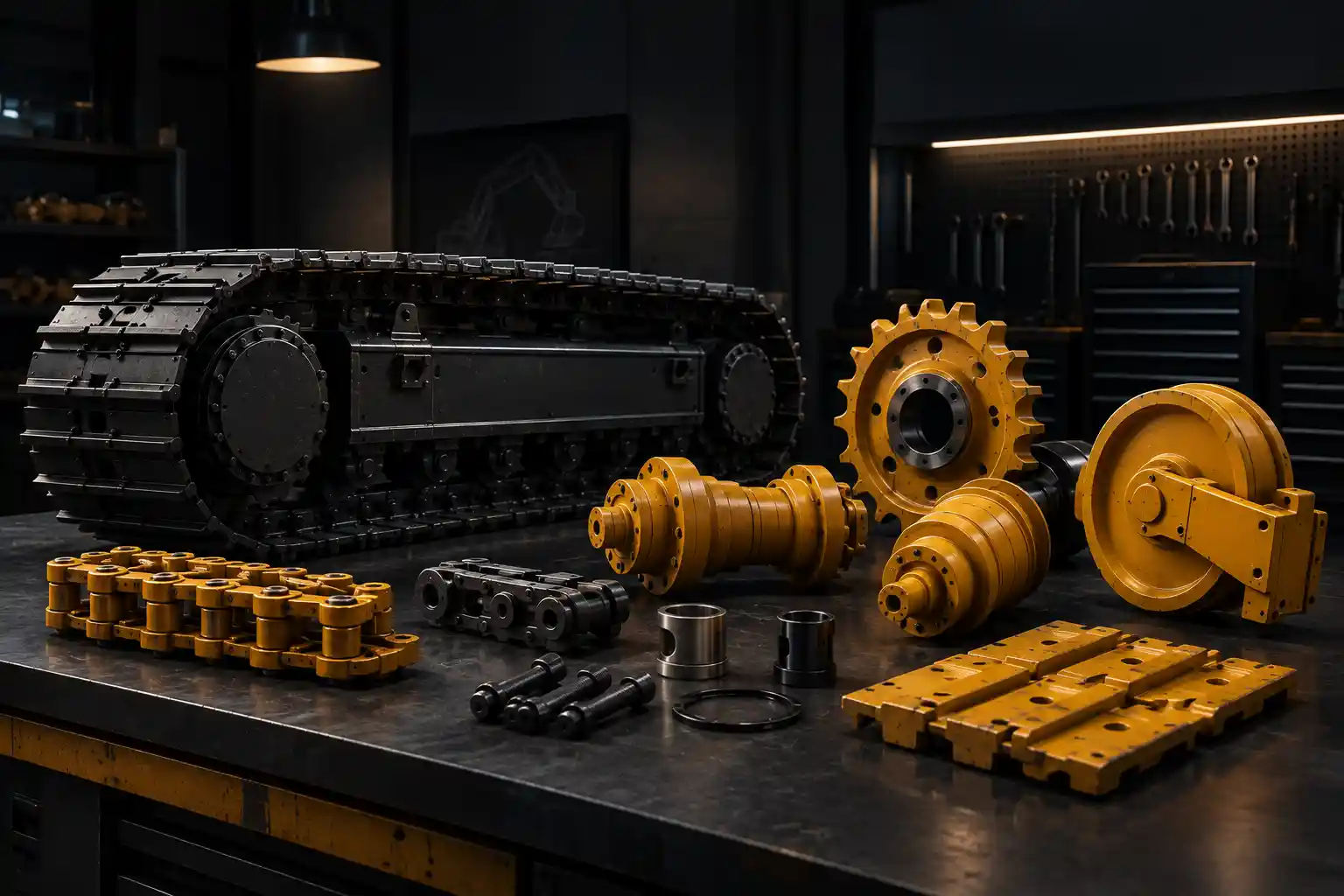
Sitting beneath the house is the undercarriage, which is deep enough a category that we've covered it in full in a separate guide. In short, the core excavator machine parts name list here includes the track chain, or track link assembly, the track shoes, the track rollers, the carrier rollers, the idler assembly and the sprocket. Together these carry the machine's weight, provide traction and drive the track around the frame, and because they run in constant contact with abrasive ground, they wear faster than almost any other system on the machine. Undercarriage wear typically accounts for 30–50% of a tracked machine's lifetime maintenance cost, which is why it deserves its own dedicated treatment rather than a single line in a general glossary.
5. Finding the Right Excavator Parts List for Your Machine
General reference material, whether that's this guide, a printed catalogue, or an excavator parts name pdf saved from a dealer site, is genuinely useful for learning terminology. It isn't a substitute for a machine-specific reference once you're actually ordering, though. Specification variation is common even within the same model name, so the safest approach is to confirm the part name against a general guide like this one, then verify exact specifications, dimensions and OEM part numbers against your specific machine before placing the order.
Keeping a record of your machine's make, model and serial number, along with photographs of the part in question, makes that verification step considerably faster the next time a replacement is needed.
Frequently Asked Questions
- What are the three main sections of an excavator?
- The front attachment, which includes the boom, arm and bucket, the house, which includes the cab, engine, hydraulics and counterweight, and the undercarriage, which includes the tracks, rollers, idler and sprocket.
- What is the difference between the boom and the arm?
- The boom is the first section pinned to the house, while the arm, or stick, connects the boom to the bucket. Each has its own hydraulic cylinder and contributes separately to the machine's reach and digging depth.
- Why do bucket teeth wear out faster than other parts?
- They make first contact with the material being dug and are deliberately designed as sacrificial, replaceable components, specifically so the more expensive bucket structure underneath them doesn't wear instead.